Overview
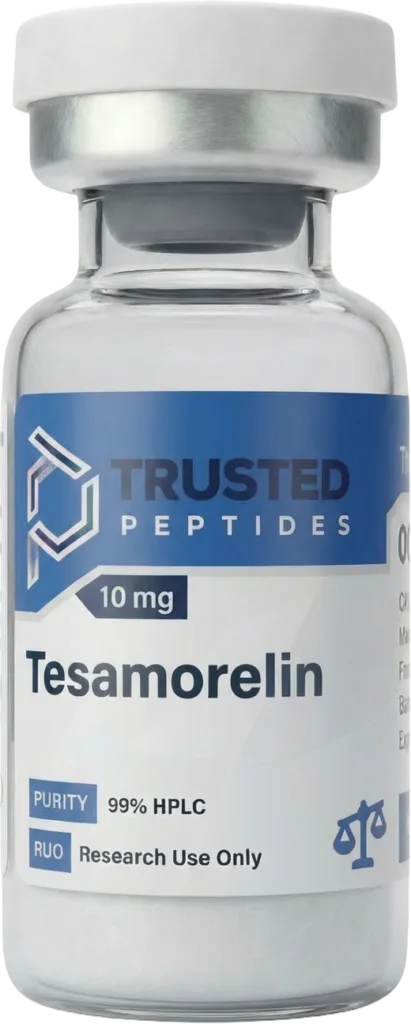
Tesamorelin is a synthetic, stabilized analogue of growth hormone–releasing hormone (GHRH; also called growth hormone–releasing factor, GRF). In laboratory settings it is used as a tool compound to study GHRH receptor (GHRHR) activation and downstream signaling within the GH/IGF-1 axis.
For research use only (RUO). Not for human or veterinary use.
Biochemical characteristics
- Class: GHRH/GRF analogue (44–amino-acid peptide)
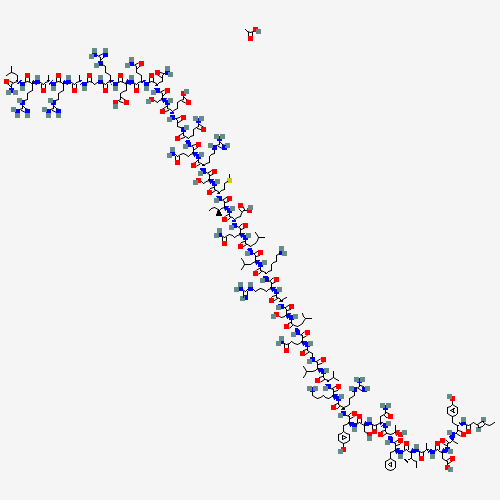
- Key structural feature: an N-terminal hexenoyl (C6) moiety (C6 chain with a double bond at position 3) attached to the N-terminal tyrosine residue, and commonly supplied as an acetate salt.
- Common identifier: Tesamorelin acetate (CAS commonly listed: 901758-09-6)
Sequence (conceptual, N-terminal–modified): Hexenoyl-Tyr-Ala-Asp-Ala-Ile-Phe-Thr-Asn-Ser-Tyr-Arg-Lys-Val-Leu-Gly-Gln-Leu-Ser-Ala-Arg-Lys-Leu-Leu-Gln-Asp-Ile-Met-Ser-Arg-Gln-Gln-Gly-Glu-Ser-Asn-Gln-Glu-Arg-Gly-Ala-Arg-Ala-Arg-Leu
How tesamorelin is used in research
Researchers commonly use tesamorelin as a GHRHR agonist to evaluate receptor pharmacology and endocrine signaling dynamics in controlled experimental systems.
- Receptor pharmacology: ligand–receptor binding, potency comparisons, and activation assays (e.g., reporter systems)
- Second-messenger readouts: canonical Gs / adenylyl cyclase / cAMP signaling and downstream pathway mapping
- Axis-level studies: experimental models assessing GH pulse physiology, IGF-1–associated biomarkers, and feedback regulation (model-dependent)
- Method development: stability- and handling-sensitive workflows for peptide ligands (assay optimization, batch comparability)
Mechanistic context
In established physiology, endogenous GHRH acts on pituitary somatotroph cells to stimulate the synthesis and pulsatile release of growth hormone (GH). GH influences downstream pathways, including modulation of circulating IGF-1. Tesamorelin is designed to mimic GHRH activity by engaging GHRHR, a class B GPCR with well-described cAMP-linked signaling in many models.
What the human literature shows (context only)
The points below summarize published clinical findings about pharmaceutical tesamorelin as scientific background. They do not imply any intended use of this RUO material.
- Regulatory indication (U.S.): tesamorelin is the active ingredient in FDA-approved products for reduction of excess abdominal fat in HIV-infected adults with lipodystrophy. It is not indicated for weight-loss management.
- Visceral adipose tissue (VAT): randomized trials in HIV-associated abdominal fat accumulation reported significant VAT reductions (often cited in the ~15–20% range, study-dependent) and associated metabolic readouts.
- Cognition research: in a controlled trial in older adults (including participants with mild cognitive impairment), daily tesamorelin (as a stabilized GHRH analogue) was associated with favorable effects on composite cognition measures, especially executive function; authors noted that longer-duration studies were needed.
Form and analytical documentation
- Form: typically supplied as a lyophilized powder to support stability during storage and shipping.
- Common QC methods: identity and purity checks using HPLC and mass spectrometry, with batch documentation (e.g., CoA) to support reproducibility.
Storage and handling
- Store RUO peptides according to your lab’s stability program and SOPs.
- In general, keep lyophilized peptide cool, dry, and protected from light; minimize temperature cycling.
- If preparing solutions for assays, use an appropriate sterile solvent/buffer for your experimental system and avoid repeated freeze–thaw cycles by aliquoting when feasible.
RUO disclaimer
For Research Use Only (RUO). Products sold by Trusted Peptides are intended solely for in-vitro laboratory research. They are not medicines or drugs and are not approved to diagnose, prevent, treat, or cure any disease.
Not for human or veterinary use. Not for medical, diagnostic, or therapeutic use.
Selected references
- FDA labeling (tesamorelin; composition/mechanism statements): AccessData FDA — Tesamorelin label (PDF)
- Falutz J, et al. Randomized trial data on VAT outcomes in HIV-associated abdominal fat accumulation (Ann Intern Med, 2010): PubMed
- Falutz J, et al. Longer-term/extension safety and metabolic effects (J Clin Endocrinol Metab, 2010): PubMed
- Stanley TL, et al. Visceral and liver fat trial (JAMA, 2014): PubMed
- Baker LD, et al. Tesamorelin (stabilized GHRH analogue) and cognition trial (Arch Neurol, 2012): PubMed
- Dhillon S. Review of tesamorelin in HIV-associated lipodystrophy (Drugs, 2011): PubMed
- KEGG drug entry (sequence/chemical info listing): KEGG: Tesamorelin