Trusted peptides for research use only — Not for human or animal consumption

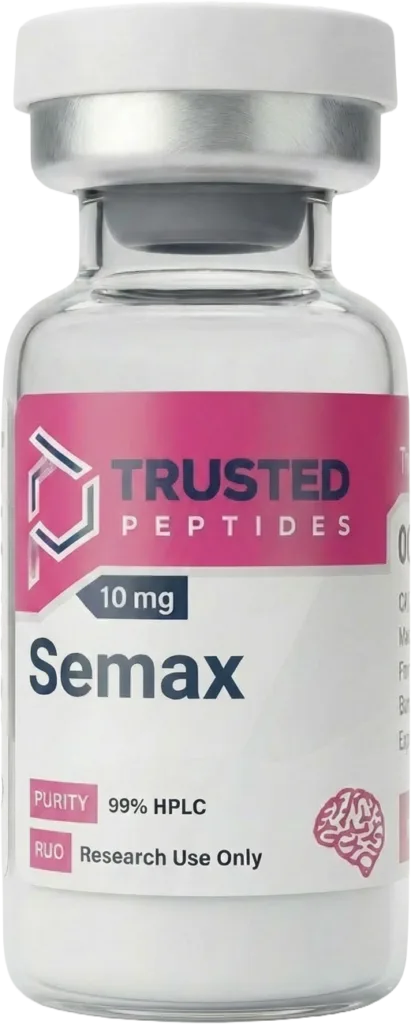
Semax

A powerful neuroactive peptide designed to enhance cognitive function and brain health. Semax is researched for its capacity to stimulate memory, increase attention, and offer significant neuroprotective effects by boosting levels of Brain-Derived Neurotrophic Factor (BDNF).

Out of stock

Want to be notified when this product is back in stock?

Not For Human or Animal Use

What is Semax?

Overview

Semax is a synthetic heptapeptide commonly described in the literature as an analog of an adrenocorticotropic hormone (ACTH) fragment and also as ACTH(4–7)-PGP (ACTH fragment + C-terminal Pro-Gly-Pro), designed to improve resistance to enzymatic breakdown in experimental settings.

At Trusted Peptides, Semax is supplied strictly as a laboratory material to support controlled research workflows exploring neurotrophin-related signaling, transcriptional responses, and CNS model endpoints.

Key Identifiers

What Researchers Commonly Study with Semax

Neurotrophin-Related Signaling (BDNF / NGF / TrkB)

Multiple preclinical studies (cell culture and animal models) have reported Semax-associated changes in neurotrophin expression or related readouts, including BDNF/NGF transcriptional dynamics and BDNF protein changes under specific experimental designs.

  • Glial cell culture work reporting rapid induction of neurotrophin mRNAs (e.g., NGF/BDNF) under study conditions.
  • In vivo rodent studies describing time-dependent effects on neurotrophin gene expression in brain regions and/or BDNF protein levels (model- and protocol-dependent).

Ischemia / Neurovascular & Immune-Pathway Transcription (Preclinical)

Transcriptomic and mechanistic papers in rodent ischemia models report Semax-associated shifts in expression of genes linked to immune response and vascular system processes, providing hypotheses for follow-up mechanistic research.

Monoaminergic Markers in Rodent CNS Studies

Some rodent research has examined Semax alongside serotonergic/dopaminergic system markers and behavioral paradigms, with results interpreted within the constraints of each model and dosing route used in the study.

Oxidative Stress & Peripheral Biomarkers (Model-Dependent)

Additional animal studies (including stress paradigms) have evaluated lipid peroxidation and related biochemical readouts in peripheral tissues (e.g., liver), as exploratory endpoints for understanding systemic responses in those models.

Form, Handling & Documentation

  • Form: Lyophilized powder (freeze-dried) for stability during storage.
  • Typical lab documentation: Many labs record sequence/CAS/registry IDs and verify identity/purity using standard analytical methods such as chromatography and mass confirmation, per internal QC requirements.
  • General handling: Use appropriate laboratory PPE and aseptic technique; avoid repeated freeze–thaw cycles of prepared solutions.

Regulatory / Context Note (Background Only)

Semax is discussed in the scientific literature as a peptide drug used in certain clinical contexts in Russia (including listing on Russia’s “Vital and Essential Drugs” list). Regulatory status differs by country and this product is supplied by Trusted Peptides for research use only.

Research Use Only

For research use only. Not for human consumption.

References are provided for scientific background and do not imply endorsement of Trusted Peptides or authorization for any human use.
Selected References

  1. Shadrina MI, et al. Rapid induction of neurotrophin mRNAs in rat glial cell cultures by Semax. PubMed
  2. Dmitrieva VG, et al. Semax and Pro-Gly-Pro activate transcription of neurotrophins/receptors in ischemia-related models. PubMed
  3. Medvedeva EV, et al. Genome-wide transcriptional analysis in rat focal ischemia (immune/vascular gene sets). Full text (PMC)
  4. Eremin KO, et al. Semax and dopaminergic/serotonergic system markers in rodents. PubMed
  5. Bobyntsev I, et al. ACTH(4–7)-PGP (Semax) and lipid peroxidation / stress-model liver readouts (Russian-language record). PubMed
  6. Ivanov AV, et al. Semax and hepatocyte morphofunctional state under chronic stress (animal model). PubMed
  7. Radchenko AI, et al. Review discussing Semax structure (ACTH fragment + PGP) and Russia clinical/listing context. Full text (PMC)

Molecular Structure

Source: Pubchem
CAS #:
80714-61-0
Formula:
C37H51N9O10
Molar Mass:
813.92 g/mol
Form:
White to off-white lyophilized powder

Laboratory Tests & Certificates

All peptides undergo rigorous testing to ensure pharmaceutical-grade quality for your research. Third-Party Lab Testing Independent laboratory verification and certificates of analysis (COA) are available for download.
Batch
01672028
Prod. February 4, 2026
Exp. July 12, 2028

Compliance verification required.

By continuing I aknowledge that:
  • I am at least 21 years of age
  • Products are for research use only (not for human consumption)
  • I accept the terms and conditions.
Login to shop