Overview
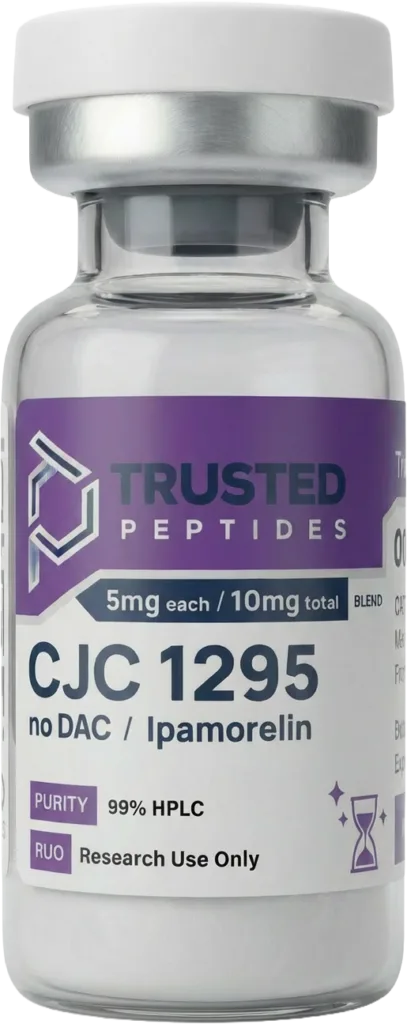
CJC-1295 (No DAC) + Ipamorelin is a laboratory-formulated peptide blend used to investigate growth hormone (GH) axis signaling in controlled experimental systems. The two components act through different receptor pathways, which is why they’re often researched together when studying pituitary signaling dynamics and GH-release patterns.
This content summarizes published research and mechanism-level biology. It does not imply medical, therapeutic, or performance outcomes.
What’s in the blend
- CJC-1295 (No DAC) — also commonly described as Modified GRF (1–29), a stabilized analog of the endogenous GH-releasing hormone (GHRH) fragment used to study GHRH receptor signaling.
- Ipamorelin — a synthetic pentapeptide studied as a growth hormone secretagogue via the ghrelin receptor (GHS-R1a / GHSR-1a). In early pharmacology work, ipamorelin was characterized as a relatively selective GH secretagogue in preclinical models compared with some earlier GHRPs.
Mechanistic context (research framing)
Researchers typically model these two pathways as complementary inputs into somatotroph (pituitary) GH release:
- GHRH pathway (CJC-1295 No DAC / Mod GRF 1–29): GHRH receptor signaling is commonly associated with Gs → cAMP/PKA cascades that promote GH synthesis/secretion in pituitary systems.
- Ghrelin/GHS pathway (Ipamorelin): The ghrelin receptor (GHSR-1a) is a GPCR involved in GH secretagogue signaling, classically linked with G-protein–mediated intracellular signaling (including Gq-linked signaling in many models), and is studied for its role in endocrine regulation and receptor cross-talk.
Why researchers combine GHRH + GHS agonism
In the GH literature, GHRH and GH secretagogues (GHS/GHRPs) are frequently discussed as distinct but complementary stimulatory inputs that can produce synergistic GH-release responses depending on the model, timing, and endocrine context. This is one reason blends like CJC-1295 (No DAC) + ipamorelin are used to explore:
- Receptor cross-talk (GHRH receptor + GHSR-1a interactions)
- Pulse dynamics and secretory patterning in pituitary-focused assays
- Second-messenger readouts (e.g., cAMP-associated vs. calcium/PLC-associated signaling endpoints)
Common research applications
- Dual-receptor signaling assays (GHRH receptor vs. GHSR-1a pathway interrogation)
- GH-axis kinetics studies (timing, pulsatility, and stimulus patterning)
- Downstream biomarker modeling in preclinical systems (often including IGF-axis endpoints where appropriate for the model)
- Comparative secretagogue studies (contrasting ipamorelin with other GHS/GHRPs and GHRH analogs)
Note: Human data exist for certain CJC-1295 formulations (notably long-acting versions) demonstrating increases in GH and IGF-I in controlled clinical pharmacology contexts. This does not establish outcomes for any specific blend or route of use outside of research settings.
Form and analytical confirmation
Peptides for laboratory work are typically supplied as lyophilized (freeze-dried) material to support stability and accurate handling. Identity and purity are commonly assessed using analytical methods such as:
- HPLC (high-performance liquid chromatography)
- MS (mass spectrometry)
If available for your batch, provide the COA (and any HPLC/MS summaries) alongside the product listing.
Storage and handling (general guidance)
- Protect from moisture and light: keep vials tightly sealed and stored dry.
- Lyophilized storage: many peptide handling guides recommend cold storage (commonly −20 °C, and −80 °C for longer-term or more sensitive materials), protected from light.
- Before opening a cold vial: let it reach room temperature before opening to minimize condensation and moisture uptake.
- After reconstitution: solutions are generally less stable than dry powder—use single-use aliquots and avoid repeated freeze–thaw cycles.
- Solution stability varies: shelf life depends on peptide sequence, solvent, pH, concentration, and storage temperature—treat any “days/weeks” estimate as model- and handling-dependent.
RUO disclaimer
For Research Use Only (RUO). Products sold by Trusted Peptides are intended solely for in-vitro laboratory research. They are not medicines or drugs and are not approved to diagnose, prevent, treat, or cure any disease.
Not for human or veterinary use. Not for medical, diagnostic, or therapeutic use.
Selected references
- Kojima M, et al. Ghrelin is a growth-hormone-releasing acylated peptide from stomach. Nature. 1999. PubMed
- Raun K, et al. Ipamorelin, the first selective growth hormone secretagogue. Eur J Endocrinol. 1998. PubMed
- Teichman SL, et al. Prolonged stimulation of GH and IGF-I by CJC-1295 in healthy adults. J Clin Endocrinol Metab. 2006. PubMed
- Ionescu M, Frohman LA. Pulsatile secretion of GH persists during continuous stimulation by CJC-1295. J Clin Endocrinol Metab. 2006. PubMed
- Veldhuis JD, et al. Determinants of GHRH–GHRP synergy. (human physiology paradigm). 2009. Full text (PMC)
- Sigma-Aldrich. Storage and Handling Synthetic Peptides (guide). PDF
- Thermo Fisher Scientific. Handling and Storage Instructions – Standard Peptides. PDF
- Bachem. Handling and Storage Guidelines for Peptides. Article