AOD-9604
A modified fragment of the human growth hormone (HGH) molecule. AOD−9604 is investigated specifically for its potent lipolytic (fat-burning) properties, stimulating metabolism and targeting adipose tissue without impacting blood sugar levels or growth.
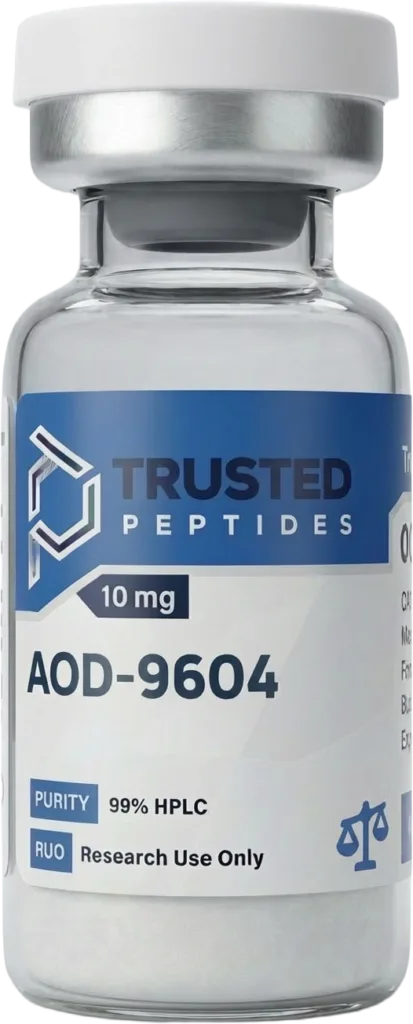
What is AOD-9604?
Overview
AOD9604 (also referenced as LAT-8881) is a synthetic peptide derived from the C-terminal “lipolytic domain” of human growth hormone (hGH). It has been used in research settings to investigate lipid metabolism, fat oxidation, and adipose-tissue signaling in controlled experimental models.
This material is supplied for research use only. The information below summarizes non-clinical and clinical research context and does not imply therapeutic or consumer use.
Identity and sequence
- Type: peptide derived from the C-terminal region of human growth hormone (hGH)
- Length: 16 amino acids
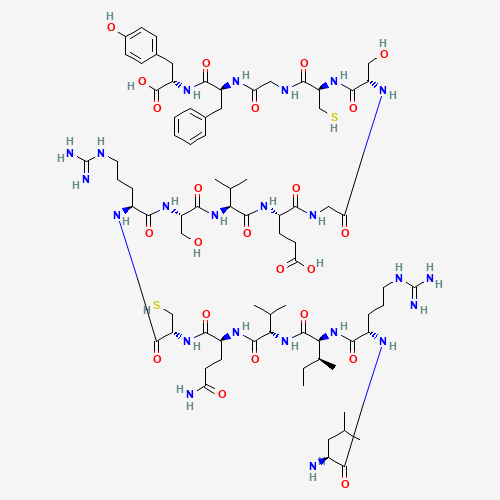
- Sequence (1-letter): YLRIVQCRSVEGSCGF
- Regulatory identifier: UNII 7UP768IP4M (Preferred Substance Name: LAT-8881)
- CAS (commonly listed): 221231-10-3
- Structural note: described in public registries as a cyclic peptide with a disulfide bond (7→14)
Note: published listings may report molecular weight and formula depending on the salt form (e.g., free base vs acetate). For lab documentation, use the values reported on your batch COA.
What researchers study with AOD9604
AOD9604 appears in the literature as a research tool for probing metabolic pathways, including:
- Adipose lipolysis sensitivity (fat breakdown signaling in adipose tissue models)
- Fat oxidation and energy expenditure readouts in animal models
- β-adrenergic signaling (especially β3-adrenergic receptor–linked effects in certain mouse studies)
- Glucose & lipid metabolism endpoints in controlled preclinical study designs
Mechanistic context from preclinical studies
In published mouse studies, AOD9604 has been investigated alongside intact hGH in obesity-related models. One proposed mechanism in these experiments involves interaction with β-adrenergic pathways (including β3-adrenergic receptor–associated effects), based on response patterns observed in wild-type vs β3-AR knockout mice.
Separate animal work has evaluated oral AOD9604 in obese rodent models (e.g., Zucker rats), reporting changes in adipose-tissue lipolytic activity within the study’s experimental endpoints.
Importantly, at least one study reports that AOD9604 does not interact with the classical hGH receptor, supporting the idea that its observed effects in those models may be mediated through pathways distinct from canonical growth-hormone receptor signaling.
Human study context (balanced summary)
AOD9604 was evaluated in multiple human studies as a candidate anti-obesity agent. A published safety/tolerability analysis summarizing several randomized, placebo-controlled trials reported:
- No increase in serum IGF-1 levels (a key safety concern with full-length hGH exposure)
- No negative effect on carbohydrate metabolism in the reported oral glucose tolerance testing
- No detected anti-AOD9604 antibodies in the assessed participants (within that analysis)
However, later development as an anti-obesity drug was discontinued after insufficient efficacy in longer clinical evaluation (e.g., a reported 24-week trial), and AOD9604 is not an approved treatment for weight loss.
Form, documentation, and analytical verification
Trusted Peptides supplies AOD9604 as a lyophilized (freeze-dried) powder to support stability and standard lab workflows. For reproducibility and traceability, peptide identity and purity are typically confirmed using:
- HPLC (purity profiling)
- Mass spectrometry (identity / mass confirmation)
Use your batch COA as the authoritative reference for purity, counterion/salt form, and analytical results.
Storage and handling (general lab guidance)
- Condensation control: if stored cold, allow the vial to reach room temperature before opening.
- Keep sealed and dry: protect from humidity and repeated air exposure.
- Long-term storage: store lyophilized peptide frozen (commonly ≤ −20 °C; colder storage is often used for extended periods).
- After reconstitution: aliquot when appropriate and minimize freeze–thaw cycles.
Research-use-only disclaimer
For Research Use Only (RUO). Products sold by Trusted Peptides are intended solely for in-vitro research and related experimental laboratory applications. These materials are not approved for diagnosing, treating, curing, or preventing any disease.
Not for human or veterinary use. Not for diagnostic or therapeutic purposes.
Selected references
Selected References (Peer-Reviewed & Reputable Reviews)
- Moré MI, Kenley D. Safety and Metabolism of AOD9604, a Novel Nutraceutical Ingredient for Improved Metabolic Health. Journal of Endocrinology and Metabolism (2014). Full text
- Stier H, Vos E, Kenley D. Safety and Tolerability of the Hexadecapeptide AOD9604 in Humans. Journal of Endocrinology and Metabolism (2013). Full text
- Heffernan MA, Summers RJ, Thorburn A, et al. The effects of human GH and its lipolytic fragment (AOD9604) on lipid metabolism following chronic treatment in obese mice and β3-AR knock-out mice. Endocrinology (2001). PubMed
- Heffernan MA, Thorburn AW, Fam B, et al. Increase of fat oxidation and weight loss in obese mice caused by chronic treatment with human growth hormone or a modified C-terminal fragment. International Journal of Obesity (2001). PubMed
- Ng FM, Sun J, Sharma L, et al. Metabolic studies of a synthetic lipolytic domain (AOD9604) of human growth hormone. Hormone Research (2000). DOI
- Misra M, et al. Obesity Pharmacotherapy: Current Perspectives and Future Directions. (Contains clinical-program context for AOD9604.) Diabetes, Metabolic Syndrome and Obesity: Targets and Therapy (2013). PMC full text
- Valentino MA, Lin JE, Waldman SA. Central and Peripheral Molecular Targets for Anti-Obesity Pharmacotherapy. (Discusses AOD9604 program outcome/termination context.)
Clinical Pharmacology & Therapeutics (2010). PMC full text - Bray GA. Drug Treatment of the Overweight Patient. (Includes AOD9604 trial summary in review context.) Gastroenterology (2007). PDF
- Hartvig RA, et al. Identification of peptide and protein doping related drug candidates. (Includes analytical identification and sequence reporting for AOD9604.) PDF
- Habibullah MM, et al. Human Growth Hormone Fragment 176–191 (AOD9604): Insights and Applications. Drug Design, Development and Therapy (2023). Full text
Molecular Structure

386264-39-7
C78H123N23O23S2
1815.12 g/mol
White to off-white lyophilized powder
Laboratory Tests & Certificates
00872028
Prod. February 4, 2026
Exp. July 18, 2028
02362027
Prod. February 4, 2026
Exp. June 13, 2027