
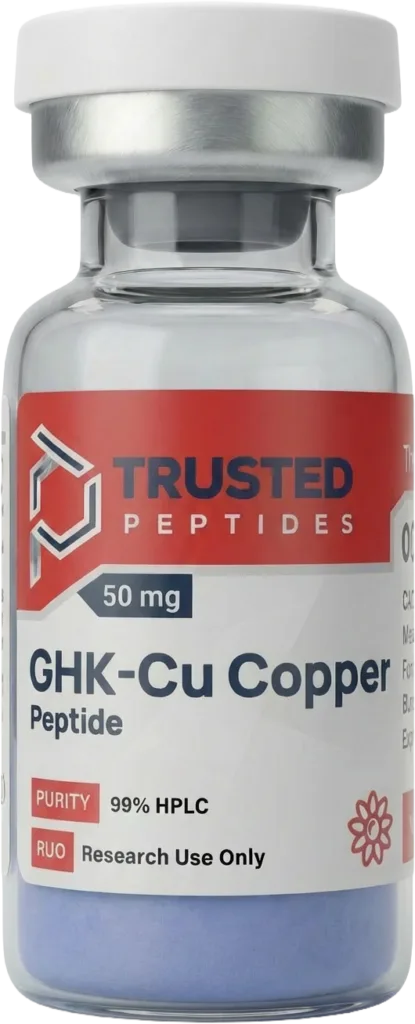
GHK-Cu Copper Peptide
$45.00
A naturally occurring copper complex celebrated for its role in skin remodeling and wound healing. GHK−Cu is widely researched for its ability to stimulate collagen and elastin production, improve skin firmness, reduce fine lines, and support hair growth
In stock
89030-95-5
340.38 g/mol
C14H23CUN6O4
50mg
Light blue lyophilized powder
What is GHK-Cu Copper Peptide?
Overview
GHK-Cu is a copper(II)-complexed form of the tripeptide glycyl-L-histidyl-L-lysine (often written as Gly-His-Lys). In the scientific literature, GHK-Cu is described as a naturally occurring copper-binding peptide present in human plasma and is widely studied as a lab tool for understanding copper biology, extracellular matrix (ECM) regulation, and cellular signaling in controlled experimental models.
All information below refers to published in-vitro and in-vivo (animal) research contexts and does not imply clinical or therapeutic use.
Identifiers and basic details
- Complex / common name: GHK-Cu (Copper tripeptide-1)
- Peptide sequence: Gly-His-Lys (Cu2+)
- CAS: 89030-95-5
- Common synonyms: Copper tripeptide-1, “copper peptide”, prezatide copper (naming can vary by reference/source)
- Formula (often listed for Copper tripeptide-1): C14H22N6O4Cu
Biochemical notes (what researchers study)
GHK-Cu is studied because the peptide can chelate copper ions and influence copper availability in biological systems. Experimental work commonly focuses on:
- ECM remodeling signals (collagen/elastin pathways, matrix turnover markers)
- Fibroblast behavior (migration and matrix-related responses in cell culture)
- Angiogenesis-related signaling in endothelial assays and wound models
- Oxidative stress and redox biology (copper-dependent reactions and downstream stress-response readouts)
Research applications
In laboratory settings, GHK-Cu has been used in studies involving:
- Dermal fibroblast and keratinocyte culture assays (ECM synthesis/turnover markers)
- Endothelial assays and animal wound models (angiogenesis and repair-related endpoints)
- Inflammation and stress-response models where copper handling/redox balance is relevant
- Gene-expression profiling approaches to map transcriptional changes reported after exposure to GHK/GHK-Cu in experimental systems
Mechanistic themes reported in the literature
Across published preclinical work, authors have reported associations between GHK-Cu and pathways involved in:
- TGF-β–related signaling and scar/wound-healing biology (context-dependent; cell-model specific)
- Matrix metalloproteinases (MMPs) and inhibitors in ECM turnover
- Inflammatory mediator readouts in injury/inflammation models
- Antioxidant/stress-response markers linked to copper/redox biology
Important: these are research observations from specific models. They do not establish safety, efficacy, or outcomes in humans outside of controlled studies.
Form, quality, and analytical confirmation
GHK-Cu supplied for laboratory work is typically provided as a lyophilized (freeze-dried) material to support stability and accurate weighing. Identity and purity are commonly verified using analytical methods such as:
- HPLC (high-performance liquid chromatography)
- MS (mass spectrometry)
If available for your batch, include your COA / HPLC / MS documentation on the product page or upon request.
Storage and handling (general lab guidance)
- Keep dry and protected from light: lyophilized peptides can be hygroscopic; moisture exposure may reduce stability.
- Temperature: for best stability, store lyophilized peptides cold (commonly ≤ −20 °C; colder is often preferred for long-term storage).
- Before opening a cold vial: allow it to reach room temperature before opening to reduce condensation/moisture uptake.
- If preparing solutions: aliquot to minimize freeze–thaw cycles; peptide solutions are generally less stable than the dry (lyophilized) form.
RUO disclaimer
For Research Use Only (RUO). Products sold by Trusted Peptides are intended solely for in-vitro laboratory research. They are not medicines or drugs and are not approved to diagnose, prevent, treat, or cure any disease.
Not for human or veterinary use. Not for medical, diagnostic, or therapeutic use.
Selected references
- Pickart L, Margolina A. Regenerative and Protective Actions of the GHK-Cu Peptide in the Light of the New Gene Data. Int J Mol Sci. 2018. Full text (PMC) • PubMed
- Gruchlik A, Chodurek E, Dzierzewicz Z. Effect of GLY-HIS-LYS and its copper complex on TGF-β secretion in normal human dermal fibroblasts. Acta Pol Pharm. 2014. PubMed
- Mulder GD, et al. Enhanced healing of ulcers in patients with diabetes by topical treatment with glycyl-L-histidyl-L-lysine copper. Wound Repair Regen. 1994. PubMed (search)
Molecular Structure
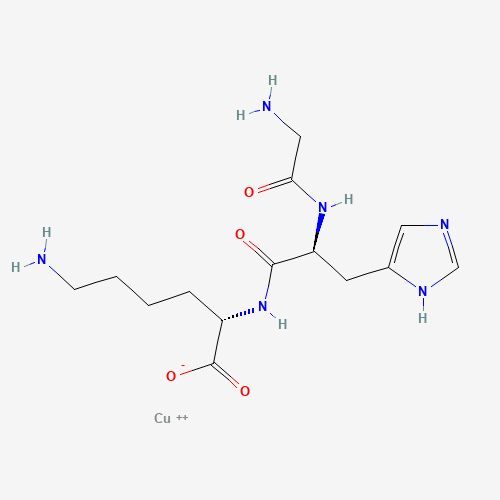
89030-95-5
C14H23CUN6O4
340.38 g/mol
Light blue lyophilized powder
Laboratory Tests & Certificates
01272028
Prod. January 29, 2026
Exp. July 13, 2028
In stock