
Why this matters
In peptide research, your “starting material” quietly determines everything downstream: assay noise, reproducibility, unexpected activity, and even whether results are publishable. Two vials labeled the same can behave very differently depending on synthesis quality, purification, and analytical verification.
This is the practical overview of how research peptides typically go from a sequence on a screen to a vial in your freezer—and what to look for when you’re choosing a supplier.
Step 1: The peptide is assembled (usually via SPPS)
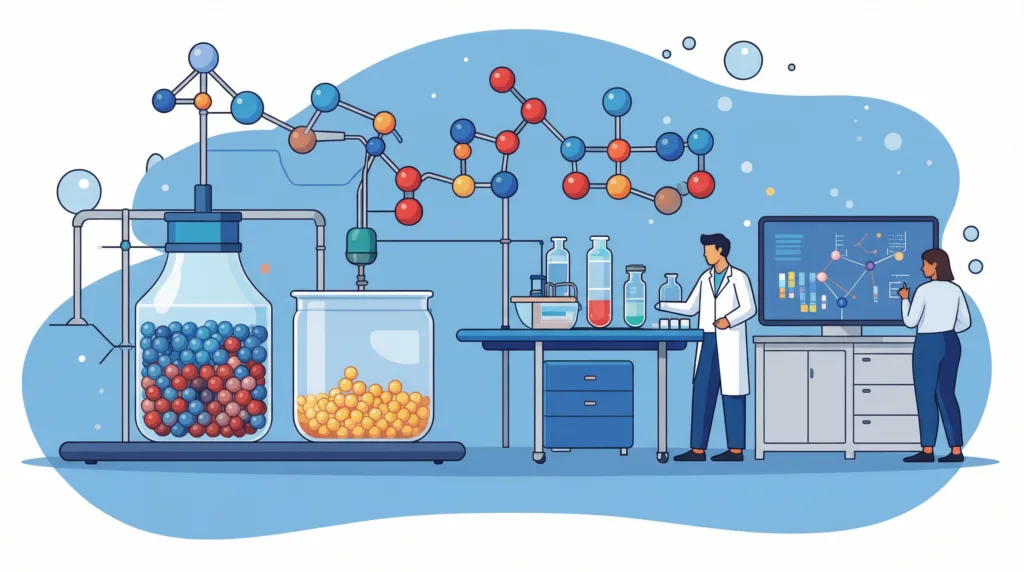
Most synthetic peptides are produced with solid-phase peptide synthesis (SPPS): the growing peptide chain is anchored to a solid resin, and amino acids are added one at a time in repeating cycles. The resin makes it easy to wash away excess reagents between steps, which is a big reason SPPS became the industry standard.
A typical SPPS cycle includes:
- Deprotection (unlock the reactive site)
- Coupling (add the next amino acid)
- Capping (optional: block any unreacted chains to reduce deletion impurities)
- Washes (reset for the next cycle)
Most modern workflows use Fmoc-SPPS, a widely adopted variant with a predictable protection/deprotection strategy and broad compatibility.
Step 2: Cleavage, then “crude” reality
After assembly, the peptide is cleaved from the resin and side-chain protecting groups are removed. At this stage you have crude peptide—a mixture that can include:
- Truncated sequences (deletions)
- Incorrect couplings (substitutions)
- Side products from chemical reactions during synthesis
- Oxidized or modified residues (depending on sequence)
Crude peptide is normal. What matters next is how well it’s purified and characterized.
Step 3: Purification (often RP-HPLC)
Purification is commonly done using high-performance liquid chromatography (HPLC)—especially reversed-phase HPLC (RP-HPLC)—because it’s effective across a wide range of peptide sizes and chemistries.
In simple terms, HPLC separates components based on how they interact with the column and solvent system. That’s how you isolate the main peptide peak from closely related impurities.
Step 4: Verification (the “identity + purity” checkpoint)
Two pillars show up again and again in peptide verification:
1) Mass spectrometry (MS): confirms the peptide’s molecular mass (and can help detect related species).
2) Analytical HPLC: estimates purity and gives a chromatographic fingerprint (retention time + peak profile).
A high-quality certificate of analysis (COA) typically reports these results (and may include method details).
Step 5: Reference standards and lot traceability
In regulated environments (and increasingly in serious research workflows), reference materials/standards are used to improve confidence in identity, purity, and quantitative strength. Even if you’re not working under GMP, the mindset matters: clear lot numbers, consistent analytical methods, and traceable documentation reduce surprises.
What to look for when buying research peptides
Here’s a practical checklist you can use (or publish as a buyer’s guide):
- Identity confirmation: MS data (and ideally method notes)
- Purity reporting: analytical HPLC chromatogram + stated purity
- Impurity awareness: do they acknowledge common impurity types?
- Lot tracking: lot numbers tied to COAs
- Handling guidance: storage/handling notes that reflect peptide chemistry
- Transparency: straightforward disclaimers and research-only positioning